Nicholls' Barrel Organ Chant and Hymn Tunes
Barrel No.1
1. Hanover (old 104th) - Dr W. Croft 1678-1727
2. Lord Mornington's chant - Lord Mornington 1735-1781
3. Windsor Chapel
4. Tune unknown
5. Bristol - Psalm 108, Coombs
6. Gainsborough - Isaac Smith c. 1770
7. Falcon Street - Isaac Smith c. 1770
8. Abingdon - Dr. Heighington 1679-1774
9. Chant - Thomas S.. Dupuis 1733-1796
10. Montgomery - W. Champness 1772
11. Morton - German chorale
12. Old Hundredth - German Psalter, 1551
Barrel No.2
1. Mount Ephraim - Benjamin Milgraove, c. 1769
2. Sheldon, New York or Chimes - J. Whitton, late 18th C.
3. Adeste Fidelis - arranged by J.F.Wade, 1711-1786
4. Georges (a Jera tune)
5. Irish - Dublin Collection, 1749
6. New Sabbath - T. Phillips, c. 1880
7. Oxford - Coombe, c. 1775
8. Islington - anon. c. 1760
9. Easter Hymn - Lyra Davidica 1708 & present form 1741
10. Surrey - H. Carey, 1690-1743
11. Burford - Chetham's Psalmody, 1718
12. St Anne - Dr. Croft, 1708
"When the organ was first installed Fuller presented the male members of the choir with white smocks, buckskin breeches and yellow stockings and the females with red cloaks to be worn on the day the organ was first played and afterwards."
G. Hutchinson, Fuller of Sussex: A Georgian Squire, p. 93.
Fuller had previously encouraged the psalmody in Brightling church by providing nine bassoons to accompany the singing.
The firm of Harrison & Harrison did restoration work on the organ in 1960 and 1964. The organ was more recently restored in 1999 by Stuart Stobbs and Domenic Gwynn of the firm Martin Goetze and Dominic Gwynn, Worksop, Nottinghamshire.
Funding for the 1999 restoration was made possible by grant aid and contributions from: Council for the Care of Churches, Leche Trust, Diapson Trust, Manifold Trust, Sir Paul McCartney, Colin and Robin Fox, Andrew Fox, Michael and Shuna Mulholland.
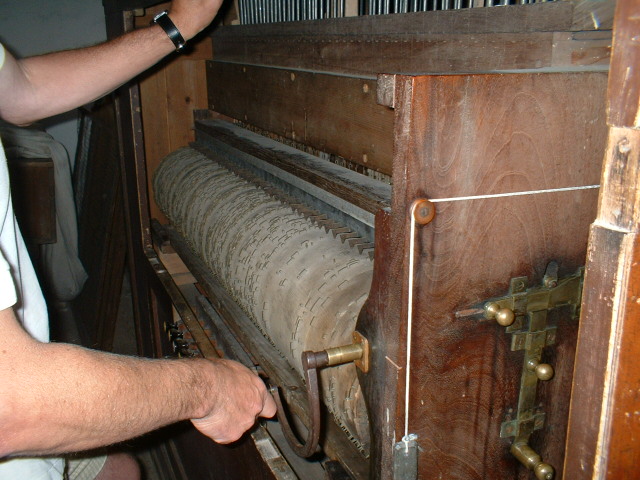
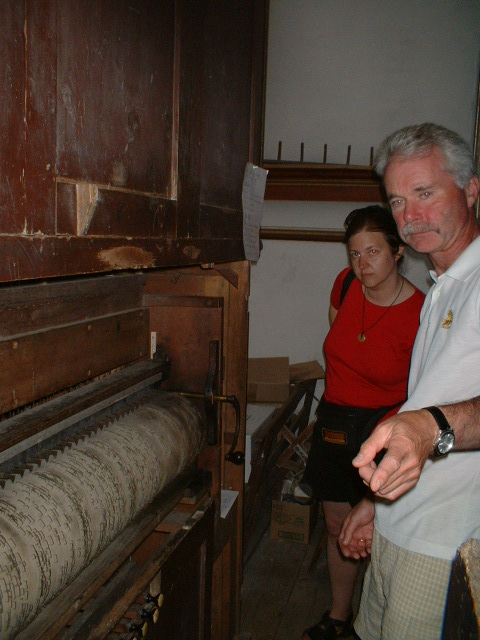
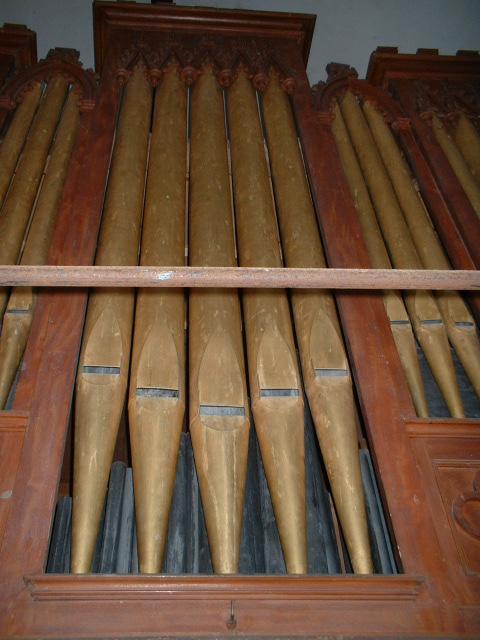
In 1820 Fuller commissioned W A A. Nicholls to make a barrel organ for St Thomas a Becket Church in Brightling. This replaced an earlier barrel organ which went to New Zealand and is currently in the Wanganui Museum. A gallery to support the new organ was also funded by Fuller. This magnificent instrument has six stops with two barrels each playing twelve tunes. A printed label at the back of the chest reads: 'W.A.A.Nicholls, son-in-law and successor to the late G.P. England, No.9 Stephen Street, Tottenham Ct. Rd.' The Nicholls barrel organ is now the largest of its kind in Britain that is still in full working order.
"The barrel organ...used a barrel (or cylinder), made of wood, with strategically placed pins to force air into a pipe to produce a sound. It comprised four basic parts;-the wind-chest, combining sound board and pipe-rack with pipes; the key frame and action parts; the bellows and reservoir, complete with operating mechanism and, finally the barrel where the tune was represented by pins and bridges."
Anne Holman, Of "Bruite Beasts and Horses' Legs": The Brightling Church barrel organs
and country church music, p. 8.
The British Institute of Organ Studies granted the barrel organ at St. Thomas a Becket an Historic Organs Certificate (Ungraded) which was awarded in 1999.